Newfoundland, Canada
Gregory River Project
A unique opportunity to explore for critical and precious minerals in a highly prospective part of Newfoundland that has been largely overlooked over the past several decades.
Overview
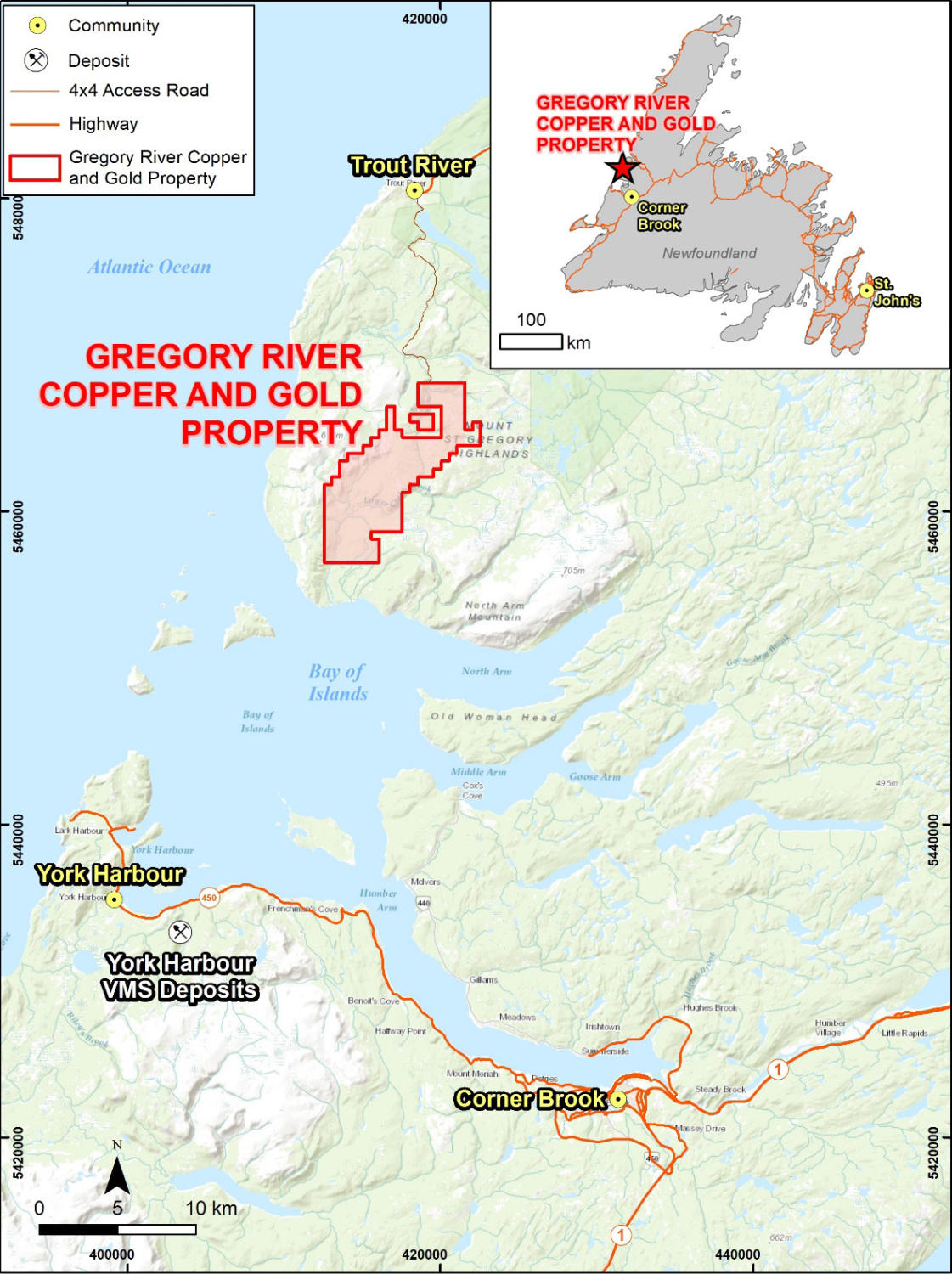
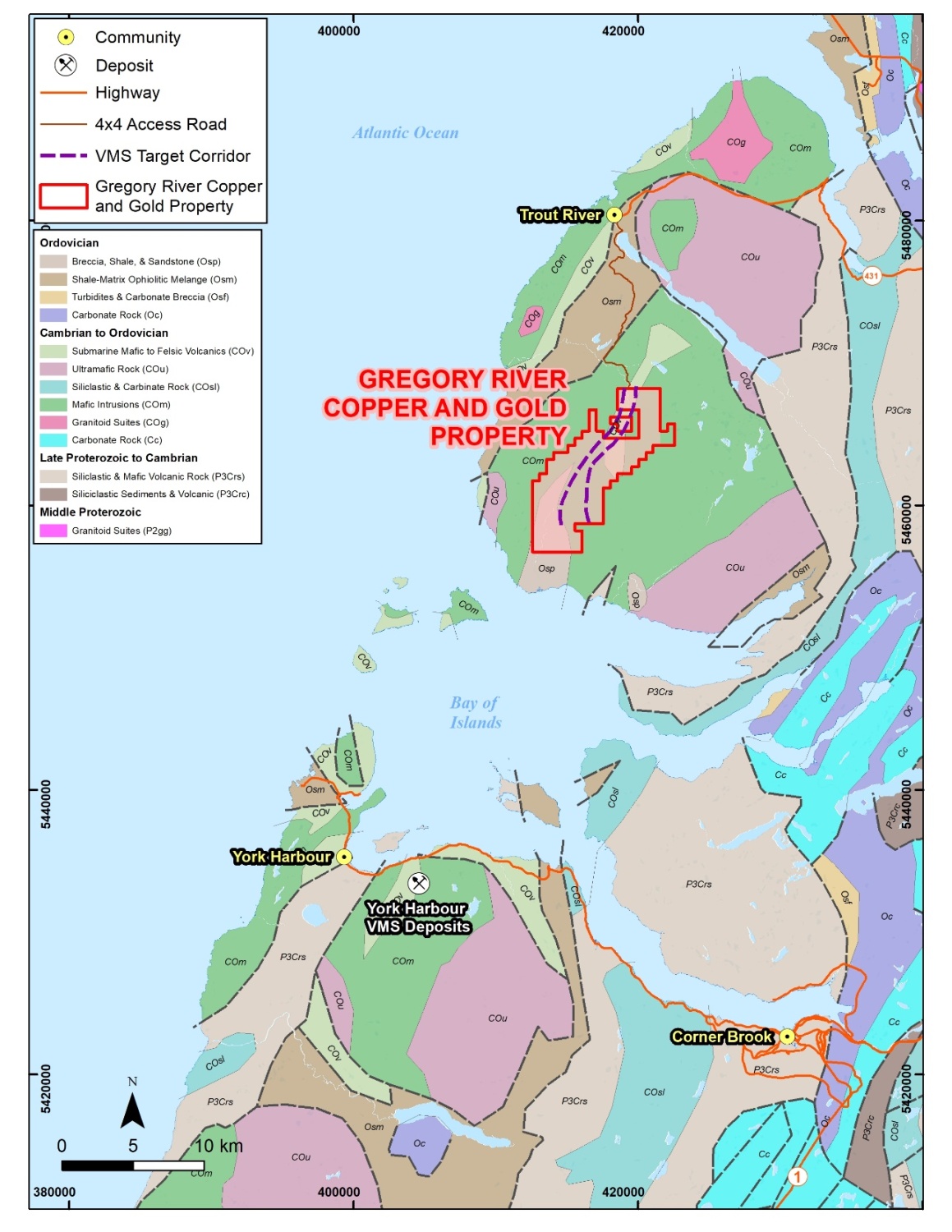
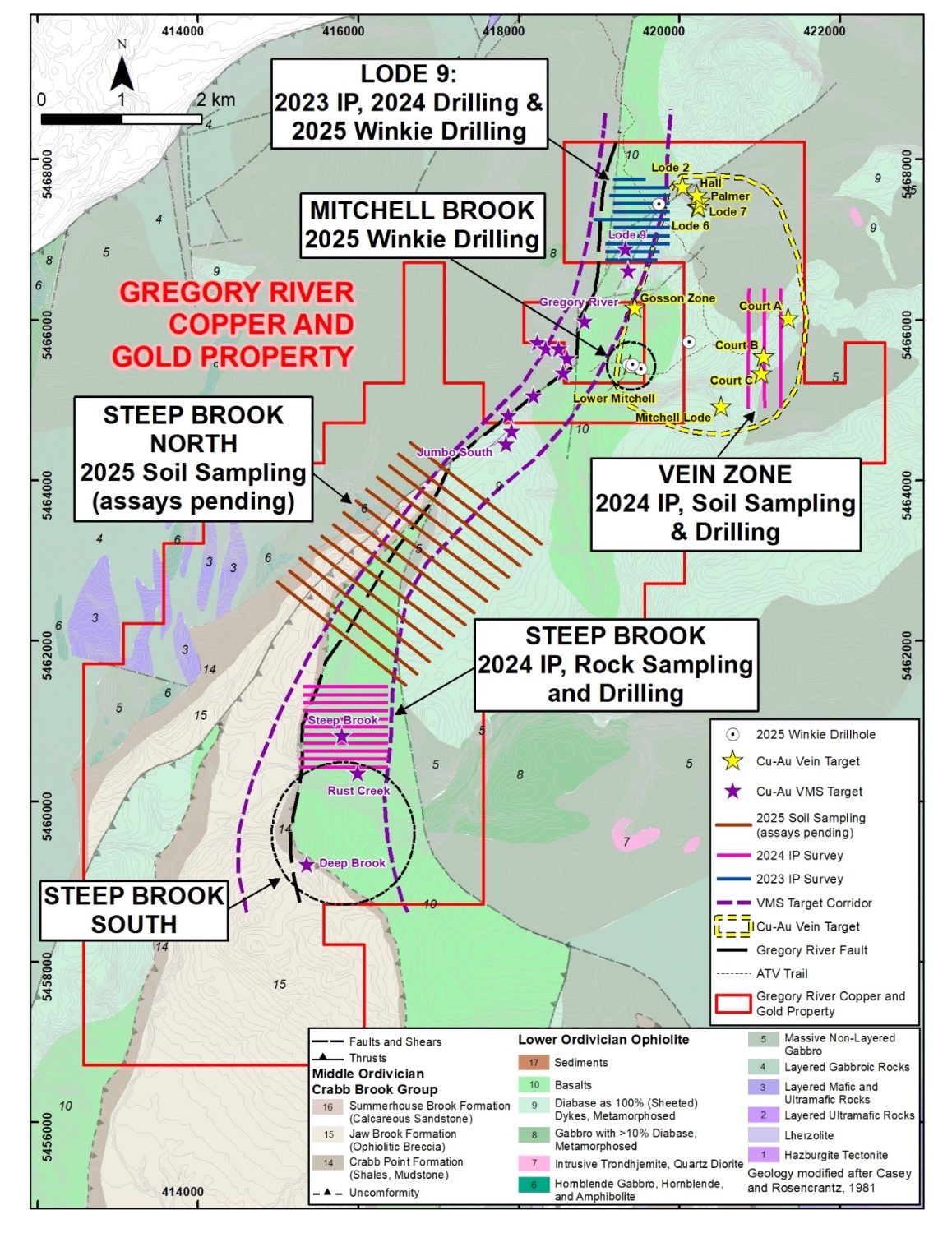
The 100%-owned Gregory River property is centered on an 11-km stretch of the Gregory River volcanogenic massive sulphide (“VMS”) target corridor that hosts several copper ± gold-zinc-silver VMS prospects, as well as a cluster of high-grade copper + gold veins. Several campaigns of early-stage exploration have significantly enhanced the potential of the property and built the framework for new discoveries.
Historical & Recent Work
A century of exploration, largely never followed up.
- 1920sCopper-rich veins first discovered at Gregory River.
- 1920s – 1950sHigh-grade, vein-type, copper-gold prospects discovered at Court A, Hall, Palmer and Mitchell. Short exploration adits completed at Palmer and Mitchell.
- 1950s28 shallow core holes (<100 m average length) drilled at Court A (17 holes) and Hall/Palmer (11 holes) targeting Cu-Au veins.
- 1980s – 1990sExploration focused on VMS mineralization along the Gregory River VMS-corridor; prospects discovered at Gregory River, Lode 9, Camp Brook/Moose Brook*, Steep Brook and others.
- 1984 – 20068 shallow core holes** (~109 m average) test VMS targets at Camp Brook/Moose Brook (4 holes*), Lode 9 (3 holes) and Steep Brook (1 hole).
- 1920s – 2023Several hundred rock samples collected, many with high-grade copper and gold values returned, along with anomalous zinc and silver; historical soil surveys over selected target areas – most of the rock and soil anomalies never followed up.
- July 2022 – August 2024Gregory River acquired; land acquisition, prospecting, sampling, soil sampling, and IP completed.
- October – December 2024Inaugural drill program.
- July – August 2025Winkie drilling discovers gold-copper-zinc mineralization at Lower Mitchell and tests regional prospects; regional soil sampling.
Copper & Gold Potential
Cyprus-type VMS targets
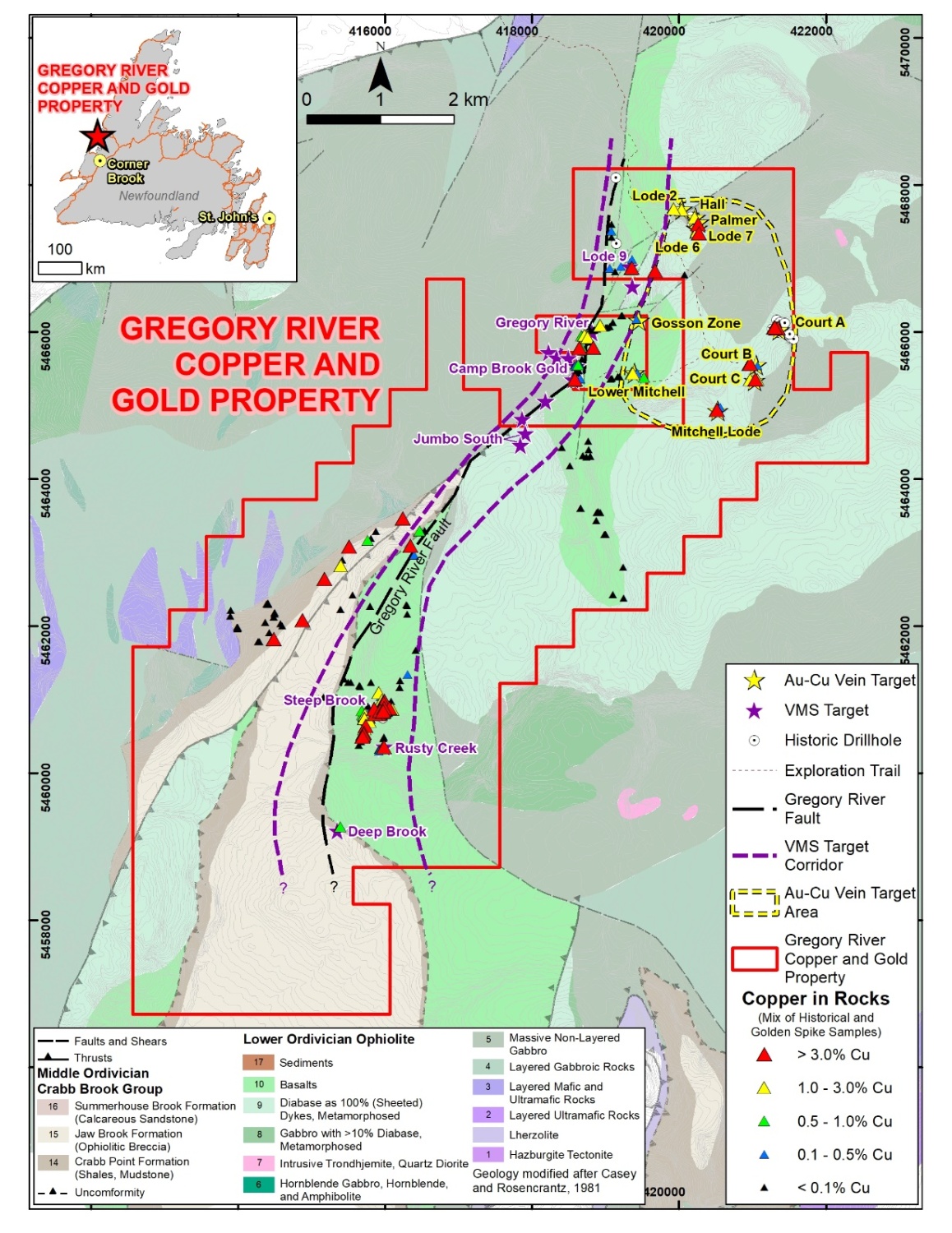
The Gregory River VMS Target Corridor represents an approximately 11-kilometre-long, underexplored trend characterized by Cyprus-type VMS targets, with eight historical drill holes reaching target depth. Cyprus-type VMS deposits in Canada typically average more than 3% copper and around 2.5 g/t gold. Within the corridor, multiple VMS targets have been identified, including Lode 9, Steep Brook, Camp Brook/Moose Brook, Gregory River, Jumbo South, and Deep Brook.
Historical and recent surface sampling has returned high-grade results averaging approximately 1.75% copper and 0.76 g/t gold, with assays reaching up to 19.6% copper and 27.4 g/t gold. During the 2024 exploration program, induced polarization (IP) surveys and diamond drilling were completed at Steep Brook and Lode 9, resulting in the discovery of new mineralized zones. In 2025, Winkie drilling led to the discovery of new copper mineralization at Lode 9 Northeast.
Copper & Gold Potential
Vein targets
The Vein Zone consists of a cluster of high-grade copper ± gold veins located in the northeast corner of the property. The area remains underexplored, with all known veins open in all directions and only limited historical drilling completed to date. Historical and recent surface sampling has returned high-grade results averaging around 2% to 5% copper, but often in excess of 10% copper, along with anomalous gold averaging around 0.1 g/t to 0.5 g/t gold, but occasionally reaching up to 3.5 g/t gold.
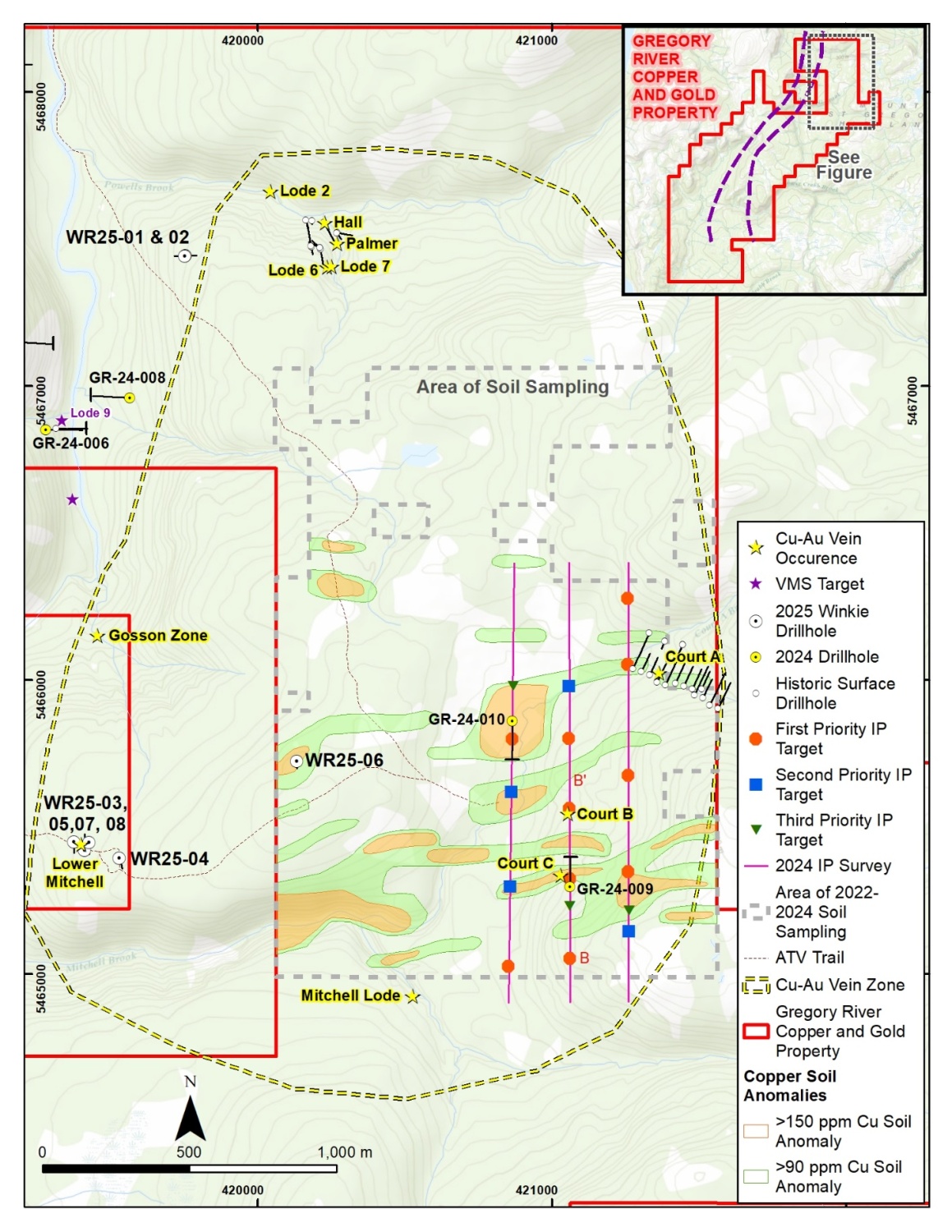
Between 2022 and 2024, soil surveying outlined several northwest- to southwest-trending, multi-element anomalies (Cu ± Zn, Au, Co, As) extending up to 1,500 metres in length, most of which occur over areas lacking outcrop or prior exploration. The 2024 exploration program included an IP survey that defined multiple high-priority anomalies, followed by two drill holes—one at Court C and one testing a new IP anomaly. In 2025, Winkie drilling led to the discovery of a wide gold-copper-zinc breccia–stockwork zone at Lower Mitchell.
Setting
Geology
The property is situated within the Lower Ordovician Bay of Islands Ophiolite Complex and is underlain by a north-northeast–trending sequence of ultramafic to mafic intrusive rocks, basaltic lavas, and narrow sedimentary zones. This same ophiolitic complex also hosts the York Harbour VMS deposit, located 27 kilometres to the south.* A broad, regional north-northeast–trending, gently plunging synform is interpreted to extend through the southern part of the property, accompanied by local anticlinal fold pairs and potentially continuing further north.
The north-northeast–trending Gregory River Fault transects the western portion of the property, accompanied by numerous fault splays and localized zones of shearing and brecciation. Many of the VMS and lode-style prospects on the property appear to be spatially associated with these structures. The VMS-style prospects at Gregory River are interpreted to be Cyprus-type deposits, primarily hosted within basaltic units near the contact with gabbro.
*Mineralization at York Harbour is hosted on an adjacent property and is not necessarily indicative of mineralization hosted on the Company’s Property.
Cu-Au-Zn
Steep Brook VMS target
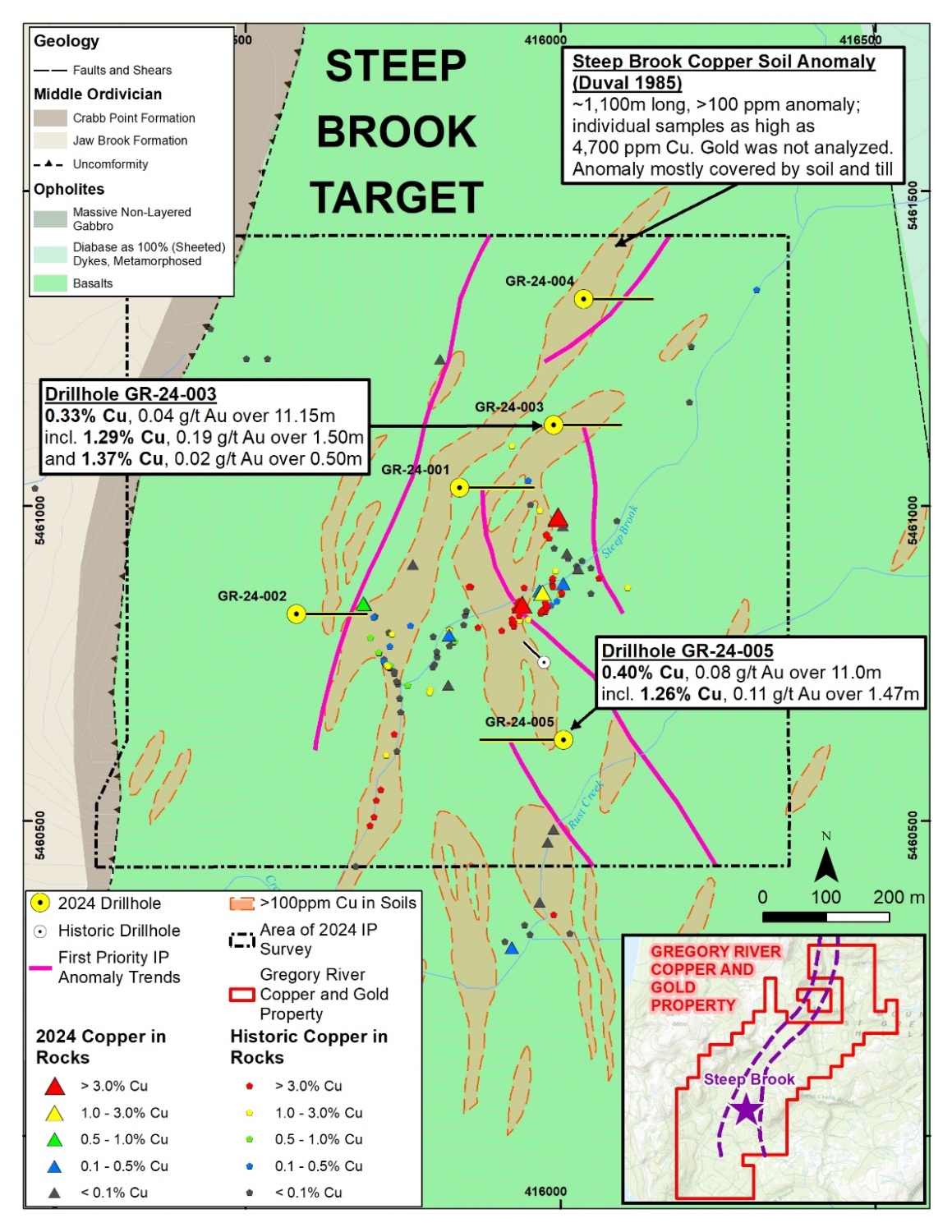
An IP Survey (2023) revealed several anomaly trends coinciding with historical soil and rock sampling anomalies. Five reconnaissance drill holes completed during 2024 totaling 921 m tested five different IP anomalies supported by geological interpretations, soil results and rock sampling. Each drill hole returned anomalous results, highlighted by:
- 0.33% copper, 0.04 g/t gold over 11.15 m (hole GR-24-003, 69.85 m to 81.0 m), including 1.29% copper, 0.19 g/t gold over 1.50 m (69.85 m to 71.35 m) and 1.37% copper, 0.02 g/t gold over 0.50 m (79.0 m to 79.5 m)
- 0.40% copper, 0.08 g/t gold over 11.0 m (hole GR-24-005, 19.0 m to 30.0 m), including 1.26% copper, 0.11 g/t gold over 1.47 m (27.27 m to 28.75 m)
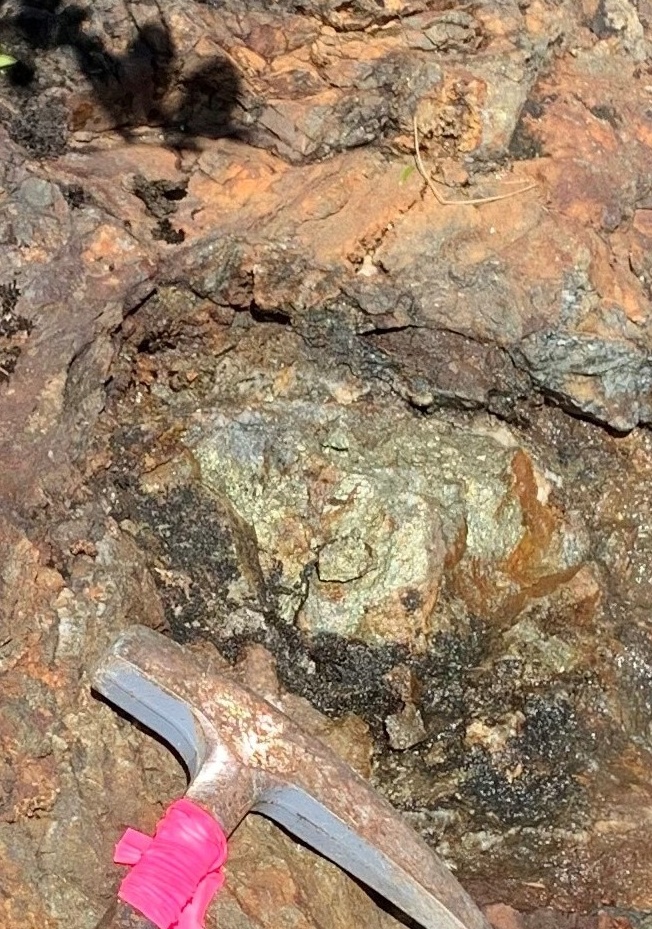
Drilling confirms the VMS target concept and that wide zones (>10 m drilled width) with higher grade intervals (>1.0% Cu) exist at Steep Brook. Next steps will be to interpret the layers of data to vector into areas where mineralization could be wider and higher in grade.
Cu-Au
Vein-style mineralization
The area hosts a cluster of east-trending, high-grade quartz-carbonate-sulphide veins. These veins typically range from approximately 0.5 m to 2 m in width, locally expanding up to 5 m to 6 m, and contain fracture-hosted and semi-massive to massive sulphides with copper content ranging from about 1% to 25%, averaging roughly 2% to 6%. Historical sampling did not consistently test for gold or other metals, but recent surface sampling indicates potential gold values between 0.1 g/t and 3 g/t.
Selected historical down-hole intercepts at Court A include (note: gold was not analysed):
- Hole 1: 2.13% Cu over 6.1 m from 90.5 to 96.6 m
- Hole 5: 4.71% Cu over 1.8 m from 94.2 to 96.0 m
- Hole 6: 4.65% Cu over 1.5 m from 71.3 to 72.8 m
- Hole 10: 9.60% Cu over 2.7 m from 76.2 to 78.9 m
- Hole 13: 4.81% Cu over 1.2 m from 74.4 to 75.6 m
Looking forward: many untested anomalies remain; deep IP anomalies suggest that veins could be sourced from intrusive bodies/structures at depth; follow-up drilling is needed.
Au-Cu-Zn
Lower Mitchell breccia–stockwork zone
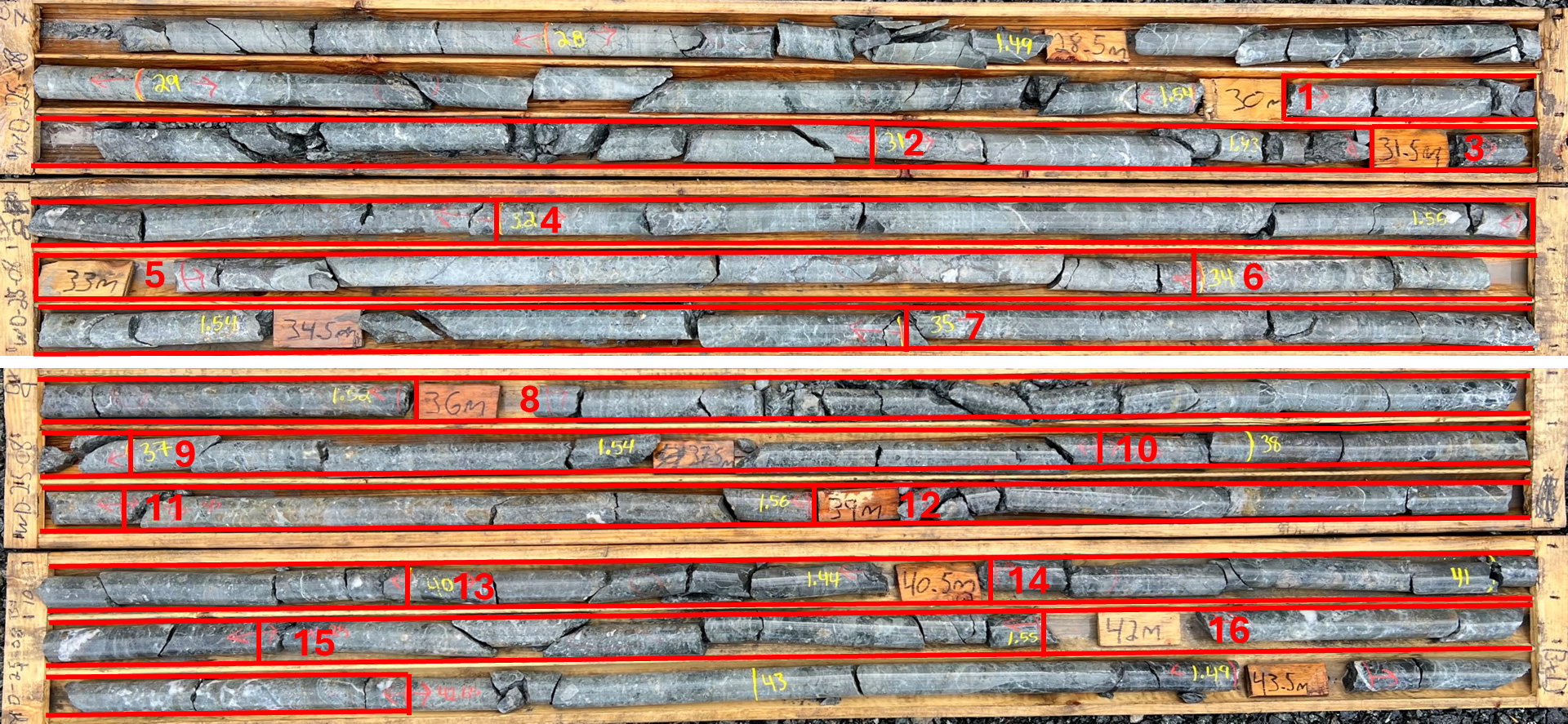
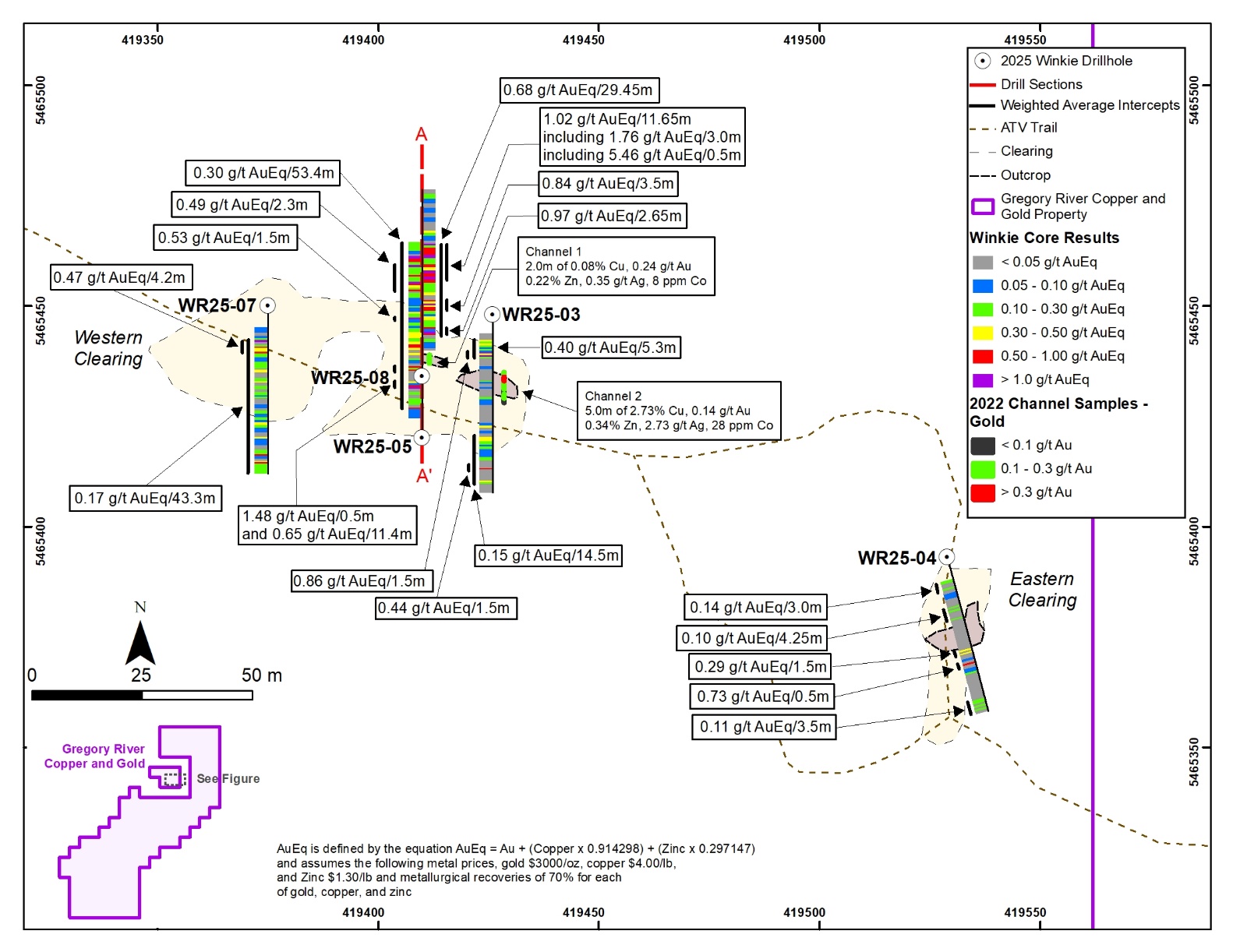
Shallow Winkie core drilling at Lower Mitchell uncovered a 40–50 metre wide, east- to east-northeast–trending breccia–stockwork zone of gold-copper-zinc mineralization, considerably broader than the 2–5 metre widths indicated by previous surface work. The zone is hosted within brecciated basalt exhibiting chlorite–carbonate alteration and areas of strong silicification.
- WD25-05: 0.65 g/t AuEq (0.45 g/t Au, 0.09% Cu, 0.42% Zn) over 11.4 m (47.1 m to 58.5 m)
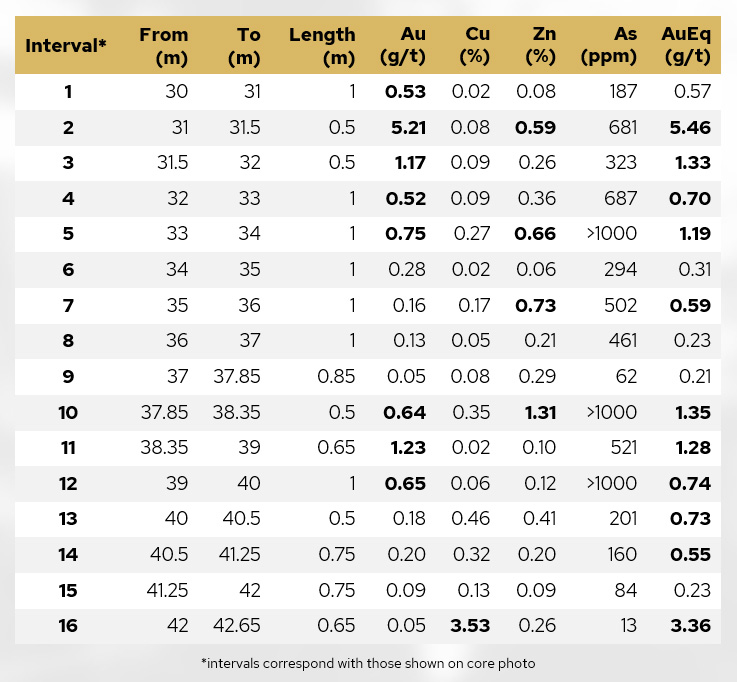
- WD25-08: 1.02 g/t AuEq (0.62 g/t Au, 0.33% Cu, 0.35% Zn) over 11.65 m (31.0 m to 42.65 m), including 1.76 g/t AuEq over 3.0 m and 5.46 g/t AuEq (5.21 g/t Au, 0.08% Cu, 0.59% Zn) over 0.5 m
Mineralization is open in all directions and additional, deeper drilling is being planned.
Historical core from Lode 9 has not been kept and the QP is unable to validate this historical drill hole and the historical sampling. However, the companies that completed the historical work were large, reputable companies that would have had sampling and quality control processes in place that were considered industry standard for the time. Insufficient drilling has been completed to determine true width of the mineralization intersected in the drill hole.